
Our first investment is designed to deliver the highest ROI, which means a follow-on has to clear a much higher bar.
One of the things we are often asked by potential LPs is how much of Fund 2 we reserve for follow-on investments. The answer is that there is no fixed percentage, and that is deliberate.
Our fund model is built around the first cheque. We invest before or during the accelerator, at the valuation agreed before the company goes through the programme. If we do our job well and the company becomes stronger during and after those 100 days, our first cheque should benefit from the greatest part of the valuation growth that follows.
That's where we typically expect the highest ROI. It's also why a follow-on isn't an automatic reward for a company doing well. By the time we consider investing again, we have more proof, but we're also investing at a later point and usually at a higher valuation. The same money could be used for another first cheque into a new company where there is more early-stage upside available.
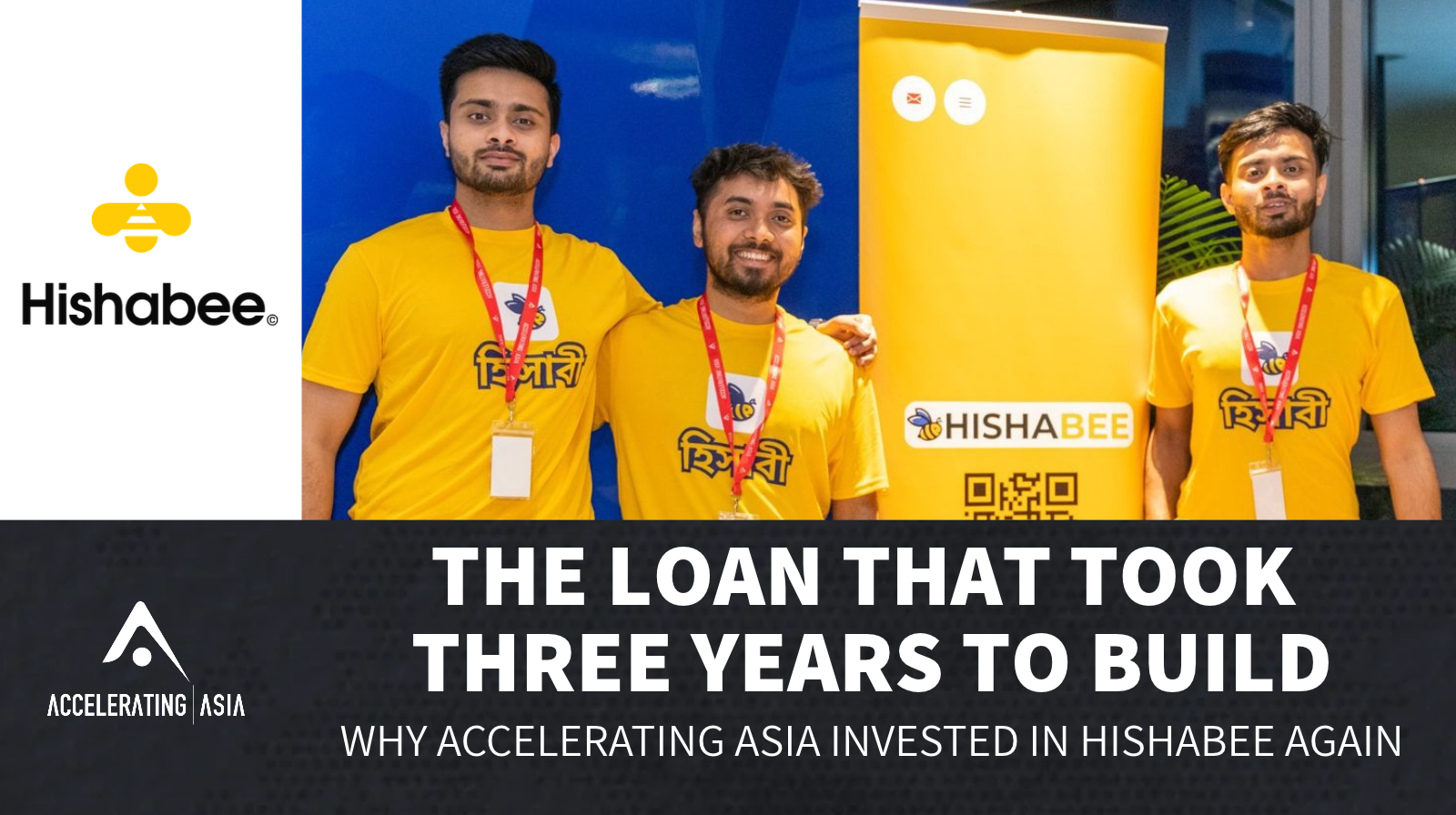
So when we decided to invest in Hishabee for a second time, we weren't simply supporting a company already in the portfolio. We were deciding that putting more Fund 2 capital into Hishabee made more sense than using that capital for another new investment. That's a much higher bar, and it's what makes this follow-on worth talking about.
What we invested in the first time
When Hishabee joined Cohort 7, it was primarily a software business helping small retailers in Bangladesh manage their day-to-day operations, sell online and create better records of what was happening inside their shops. More than 100,000 businesses were already using the platform.
Rakin and his team could also see a much larger problem sitting inside those relationships. Small retailers constantly need to buy stock, but many struggle to access formal working capital. Hishabee already had the retailers, years of business data and people on the ground. The opportunity was to use that infrastructure to help finance the stock those retailers needed to keep trading.
The idea sounds relatively straightforward when we explain it now. A retailer needs stock, a distributor wants to sell it and a bank has capital available to lend. But those three parties don't automatically become a working lending product simply because the need exists.
Hishabee needed a banking partner that could open accounts and approve loans quickly enough for the product to be useful. The team needed to assess retailers and distributors, digitise the process, manage collections and maintain the relationships on the ground. The distributor also had to participate in a model that worked differently from the way they would normally sell stock.
“This lending business we've been trying to crack for a long time,” Rakin told us in September. “It took us three years to go live.”
During those three years, the original software business continued to grow. By June 2024, Hishabee had publicly reported more than 320,000 registered businesses, US$250,000 in annual recurring revenue and 15% month-on-month revenue growth. That retailer base, the data and the team's experience in the market all helped, but none of them guaranteed the financing product would work.
The company we were looking at the second time
By Q3 2026, Hishabee had moved well beyond the company we first invested in. The financing product was live, the banking partner was funding specific inventory purchases and retailers were receiving stock rather than cash. Hishabee was providing the software, assessment and field operation around each transaction without having to fund the growing loan book from its own balance sheet.
During the quarter, Hishabee facilitated US$1.7 million in loans, an increase of 569% from Q2. Revenue grew 33.9%, and the company was profitable in each of the three months, making it Hishabee's first fully profitable quarter.
The September numbers were particularly interesting to us. It was the company's largest month for both lending and revenue, despite not adding any new suppliers or shops during the month. The growth came from more activity within the network Hishabee had already built, rather than simply adding more accounts.
There are still real risks. The company needs to manage credit performance as lending grows, expand an operation that still requires people on the ground and reduce its dependence on one banking relationship. One profitable quarter doesn't answer all of those questions, but it gave us a much stronger business to assess than the one we first backed.
Why the second cheque made sense
We have known Rakin and the Hishabee team for years, which gave us far more context than we would normally get from a few weeks of diligence. We had watched them work through delayed integrations, distributor relationships, field operations and all the other things that don't tend to appear in the clean version of a fundraising deck.
That familiarity was useful, but it could not be the reason for investing. If anything, knowing a founder well means we need to be even more careful that we aren't confusing a good relationship with a good investment decision.
We went back through the company based on where it stood now: what had changed, what the team had proven, the valuation at which we would be investing and the risks that still remained. The original cheque still has the greater return potential because we invested earlier and at a lower valuation. The case for the second cheque was that Hishabee had become a materially stronger business, while the remaining opportunity was still large enough to justify increasing Fund 2's exposure.
This is where the accelerator and fund model becomes particularly useful. We get the benefit of entering early, but we also keep learning about the company long after the programme ends. We see what founders said they would build, what actually happened and how they worked through the parts that took much longer than expected. Sometimes that gives us a reason not to invest again. In Hishabee's case, it gave us enough evidence to make an exception.
Most of Fund 2's returns will still need to come from our first cheques doing what they are designed to do, and this follow-on doesn't change that thesis. Hishabee cleared the higher bar because it had become a materially different company. We weren't being asked to invest in the same promise again. We were looking at a live financing product, growing lending, improving economics and a team we had watched do the difficult work over three years.
For us, that was enough to make the second cheque worthwhile.
Fund 2 is in final close.
Then review the fund and portfolio, or email team@acceleratingasia.com to talk through your questions with us.
Start with the fund deck. Choose your path at acceleratingasia.com/investors and we'll send access.
Ready to invest? Book a call here with a partner.
See the portfolio. Check out acceleratingasia.com/portfolio. Filter by country, sector, or fundraising status. Request an introduction directly to any CEO.
For investors and partners. Choose your path at acceleratingasia.com/investors. Whether you're looking to co-invest in individual startups or invest in the fund, the next step is there.
* Carta Q4 2025 VC Fund Performance. US benchmarks used as Asian fund comparables remain limited.
About Accelerating Asia Ventures
Accelerating Asia Ventures is an independent accelerator and venture capital fund investing in early-stage startups across Southeast and South Asia. Founded by operators, the organisation is committed to supporting founders with capital, credibility, and a long-term community.
For interviews, data requests, or portfolio introductions, contact: team@acceleratingasia.com
