
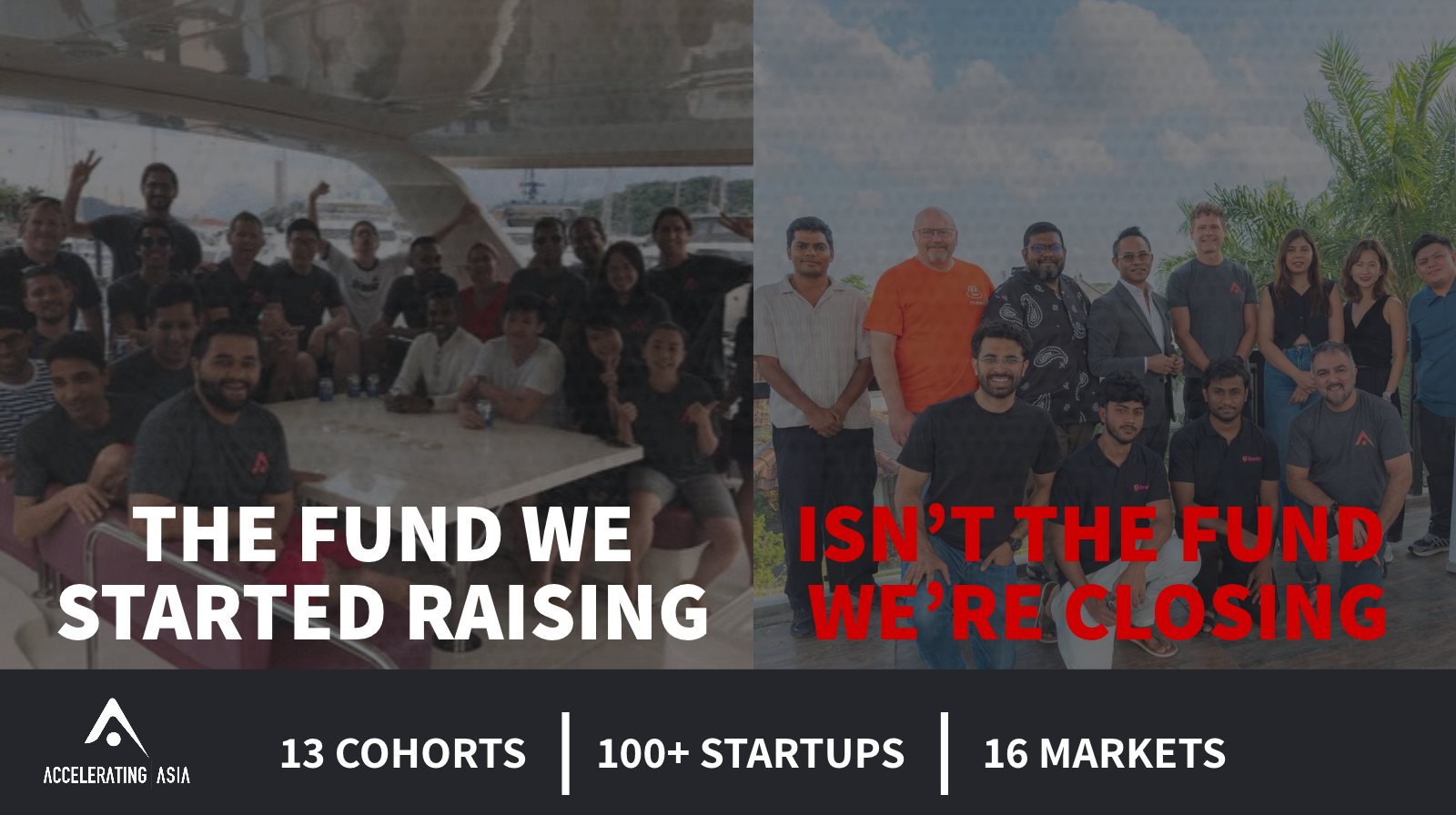
Fund 2 closes at the end of this year. For us, reaching final close isn't only about a deadline. It is also a chance to look at the fund we are closing against what we originally set out to build.
Before Accelerating Asia existed, we wrote about why the accelerator model wasn't working in Southeast Asia. We had just watched one of the region's strongest corporate accelerator programmes close despite exceeding its accelerator KPIs. Corporate programmes could disappear when the parent company changed strategy, while independent programmes faced a different problem: they needed cash to support founders and run the programme years before any return from startup equity was likely to arrive.
Most of the independent accelerators we had watched lasted about three cohorts. Honestly, the fact that Accelerating Asia is still here eight years later is pretty crazy. But it wasn't an accident. We built the business around the exact problem we had identified: an accelerator designed around founders, with a venture fund investing in the companies and other revenue supporting the programme while the investment portfolio developed.
A year later, we published Holy Sh!t, We Did It!. Cohort 1 had started with ten companies from seven markets. We ended the article by saying we hoped we would eventually be able to write another one called Holy Sh!t, It's Still Working!
Well, it looks like it's still working.
Eight years later, we have completed 13 cohorts and backed more than 100 startups across 16 markets. At the time, we were trying to prove that an independent accelerator like this could survive. It has gone much further, and worked much better, than we could have imagined.
Fund 2 has followed a similar path. When we started raising it, investors were backing Fund 1's track record, a growing portfolio and our belief that we could repeat the model at a much bigger scale. Every Fund 1 LP with the liquidity to invest again came into Fund 2. In other words, 100% of those LPs renewed. They had watched us build the first fund, seen the value of the model and decided to back us again.
Today, Fund 2 has invested in 71 companies across nine cohorts, with approximately US$7.3 million deployed. Sixty-one of those companies, or 86%, are active. Under the Fund 2 terms, a new LP joining at final close participates in the portfolio already built, with capital contribution and equalisation handled through the fund mechanics. They aren't investing only in whatever we do after they join.
That makes this a very different investment decision from the one our earliest LPs made.
What has happened since the first cheque
As of July 2026, companies across Funds 1 and 2 had raised more than US$174 million in follow-on capital from external investors. Every company accepted into the accelerator has attracted investment from outside Accelerating Asia during or after the programme. That capital came from other investors making their own decisions about the companies, and is one of the clearest external validations of what has been built across the portfolio.
The earliest companies are also reaching the stage where liquidity is becoming a real part of our work. Earlier this year, we identified at least ten portfolio companies where we expect exit opportunities within 18 months. At our stage, that doesn't necessarily mean waiting for the whole company to be acquired or go public. It can be a secondary transaction, a strategic acquisition or a later financing round that creates liquidity for our original position.
We are actively working on those opportunities now. The timing and final outcome depend on the transactions, but they are no longer theoretical lines sitting in a fund model.
Not every company will work, and the companies that do won't all develop at the same speed. The difference today is that investors can review the actual portfolio, see which companies attracted further capital, look at years of operating history and understand where the potential paths to liquidity are forming.
What has grown around the portfolio
At the beginning, almost every useful relationship had to start with our team. We found the companies, brought investors into the room, made the introductions and tried to work out who could help with whatever happened next.
That is no longer how the network works. Two founders we first met as applicants are now investors in our funds. Others are writing angel cheques, referring companies and coming back to help us assess new founders. PriyoShop is helping Thyaga enter Bangladesh, while the founders of DIGIBOX have signed SAFEs in meed and are helping the company build in the same market.
Some of the most useful sourcing now happens before a company ever reaches our application form. Alumni speak to founders, explain the selection process and do their own informal vetting before putting their name behind a referral. During selection, founders and operators give us context about markets and business models that we would struggle to get from a deck. After investment, the same network can help with customers, hiring, fundraising and market entry.
This isn't a soft community benefit sitting around the edge of the fund. It changes what we can find, what we can understand before investing and what support exists after the cheque. Capital, deal flow, operating experience and trust are now moving back through the portfolio.
It is also extremely difficult to replicate. Anybody can launch an accelerator, hire a team and start writing early-stage cheques. They can't immediately recreate eight years of shared experience across more than 100 startups and 16 markets, or the trust that makes a founder put their own capital, reputation and time behind somebody coming next.
The final window to join Fund 2
Our earliest LPs had to underwrite the thesis. An LP joining now can examine 71 Fund 2 companies, nine completed Fund 2 cohorts, approximately US$7.3 million already deployed, years of company history, more than US$174 million in follow-on capital across the wider portfolio and the exit opportunities we are actively working on. Under the Fund 2 terms, they still participate in the portfolio already built.
That combination disappears after final close. Fund 2 closes at the end of this year.
If you have been following the portfolio, attending our Demo Days or meaning to take a proper look at the fund, this is the time to do it. Review the companies, ask us the difficult questions and speak to the people who have been part of it before deciding whether you want to join us.
Fund 2 is in final close.
Then review the fund and portfolio, or email team@acceleratingasia.com to talk through your questions with us.
Start with the fund deck. Choose your path at acceleratingasia.com/investors and we'll send access.
Ready to invest? Book a call here with a partner.
See the portfolio. Check out acceleratingasia.com/portfolio. Filter by country, sector, or fundraising status. Request an introduction directly to any CEO.
For investors and partners. Choose your path at acceleratingasia.com/investors. Whether you're looking to co-invest in individual startups or invest in the fund, the next step is there.
* Carta Q4 2025 VC Fund Performance. US benchmarks used as Asian fund comparables remain limited.
About Accelerating Asia Ventures
Accelerating Asia Ventures is an independent accelerator and venture capital fund investing in early-stage startups across Southeast and South Asia. Founded by operators, the organisation is committed to supporting founders with capital, credibility, and a long-term community.
For interviews, data requests, or portfolio introductions, contact: team@acceleratingasia.com
