
He nearly didn't apply. One cohort later, DIGIBOX had grown revenue 45%.
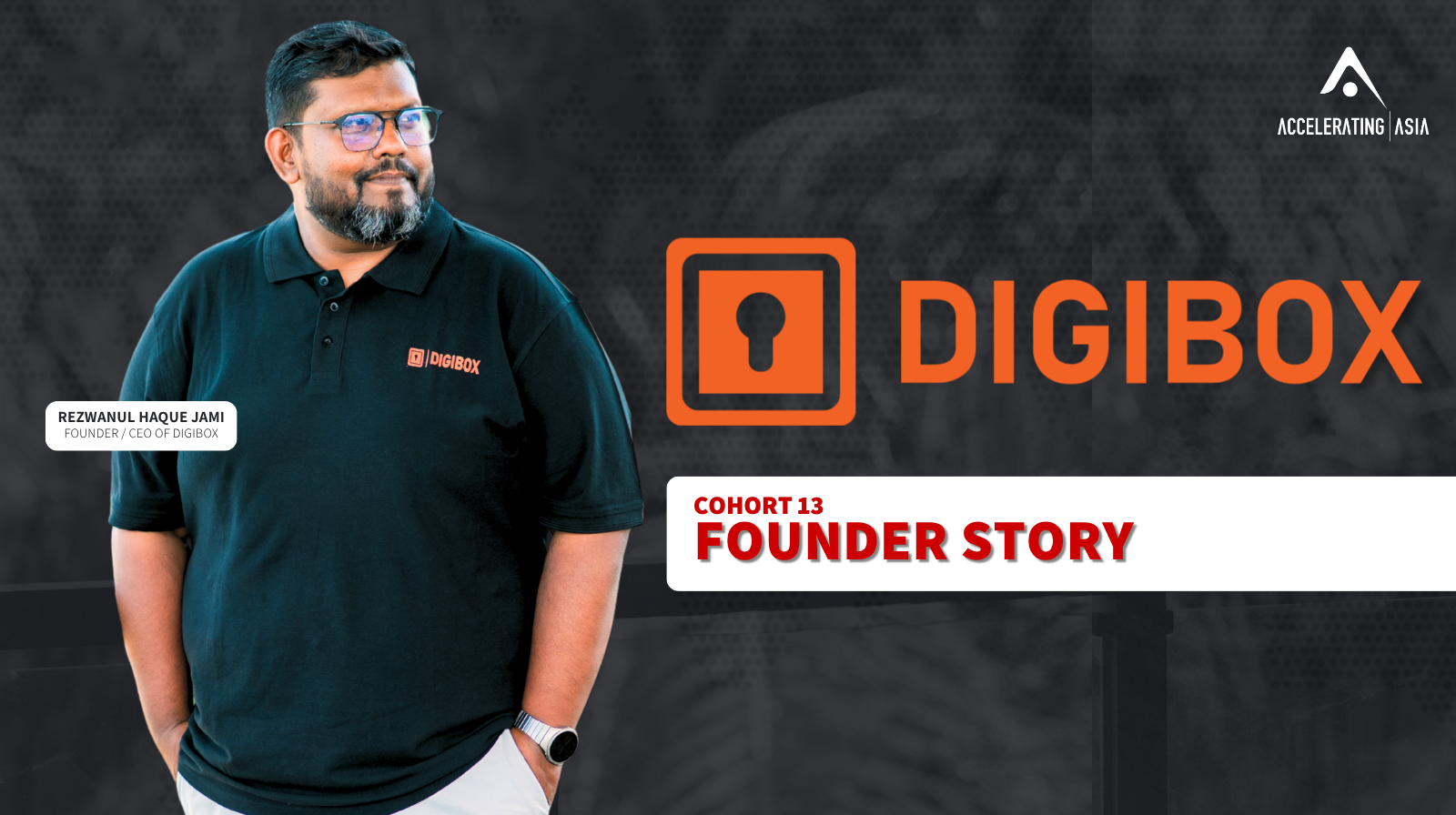
Watch Jami’s interview.
Jami had already built and exited two companies before he applied to Accelerating Asia. He knew how to build from the ground up, win customers and operate without outside capital. What he didn't know was how institutional fundraising worked. Both of his previous companies had been bootstrapped, grown with his partners and without investors, accelerator programmes or Demo Days. So when DIGIBOX started looking more seriously at venture capital, Jami was an experienced founder entering a process he had never been through before.
He didn't apply to Cohort 12. "I was a little bit fearful of how well I could do in a very competitive selection process," he told us. "I didn't even apply, but then I mustered up my courage and finally applied for Cohort 13."
That hesitation is worth talking about because founders often assume experience should make every part of company-building familiar. It doesn't. Building a profitable business, raising institutional capital and explaining a venture-scale opportunity are different skills.
DIGIBOX is a last-mile delivery-locker company from Bangladesh. Before the accelerator, it had already competed against international companies and won contracts. The operating proof was there, but Jami realised during the programme that the team wasn't communicating it properly. "We had competed with world-class companies to get contracts, but we didn't focus on it," he said. "We didn't communicate it."
That became clear during the Cohort 13 retreat in Bali. DIGIBOX was doing things that should have given investors and potential customers confidence, but the team had treated those wins as part of the normal work rather than evidence of what the company could become.
The second realisation was harder. Jami said DIGIBOX had been functioning like a business, but not like a startup. There was a chain of command, instructions went out and the team tracked KPIs. What was missing was the urgency to turn each success into the next one, and a much bigger view of how far the company could grow. That doesn't mean the company needed more startup theatre. It needed to connect the operating work with a clearer growth story, then hold itself accountable to the numbers each week.
At the start of the programme, the founders defined the metrics they believed represented progress. They then reported against them throughout the 100 days. For a hands-on founder already running the company day to day, Jami expected the programme to feel long. Instead, he said it went "like poof" because the team was implementing the work while the business kept moving.
The verified numbers show what changed:
Monthly revenue increased from US$9,300 in Week 1 to US$13,500 in Week 11, a 45% increase.
DIGIBOX's user network increased from 100,000 to 120,000.
Enterprise locations increased from 13 to 15.
Fundraising changed too. Jami had expected that an asset-heavy company from Bangladesh would struggle to convince international investors. That was his concern, rather than a claim about how every investor views Bangladesh. The work during the programme helped him communicate the business, its customer proof and the opportunity differently.
DIGIBOX closed its original round when it was full. The company later opened a small extension for a limited number of strategic investors, and that extension also closed oversubscribed. DIGIBOX isn't raising any more.
The important part isn't that an experienced founder was taught how to make a better pitch. It's that Jami learnt how to make the strength already inside the business easier for investors to understand, while the company continued growing. His advice to founders considering Cohort 14 is direct: "If you really believe that your startup is solving a real problem and can actually become successful, take this chance. Don't leave it."
He also doesn't describe Accelerating Asia as only an accelerator or a route to funding. He talks about the other founders, mentors, angels and investors as a new family and community that stays with you after the programme finishes.
Jami skipped one cohort because he wasn't sure he belonged in the selection process. One cohort later, DIGIBOX had grown revenue by 45%, closed its original round, closed a strategic extension oversubscribed and stopped raising.

If you're building a seed to pre-Series A startup in South or Southeast Asia, applications for Cohort 14 close on by 23 August to be included in priority review. Applications will remain open after that date, but later applications will be reviewed only where the selection timetable and team capacity allow.
SUBMIT YOUR APPLICATION FOR COHORT 14
Apply by August 23, 2026
US$100,000. 100 days. Up to 10 startups. We back seed to pre-Series A founders solving real problems across South and Southeast Asia.
For investors, DIGIBOX shows what the accelerator can surface: experienced operators with real customer proof who haven't yet had access to the networks or language of institutional venture capital.
Fund II is in final close, with more information at acceleratingasia.com/investors.
Start with the fund deck. Choose your path at acceleratingasia.com/investors and we'll send access.
Ask a question first. Email team@acceleratingasia.com and we'll get back to you.
Ready to invest? Book a call here with a partner.
See the portfolio. Check out acceleratingasia.com/portfolio. Filter by country, sector, or fundraising status. Request an introduction directly to any CEO.
For investors and partners. Choose your path at acceleratingasia.com/investors. Whether you're looking to co-invest in individual startups or invest in the fund, the next step is there.
* Carta Q4 2025 VC Fund Performance. US benchmarks used as Asian fund comparables remain limited.
About Accelerating Asia Ventures
Accelerating Asia Ventures is an independent accelerator and venture capital fund investing in early-stage startups across Southeast and South Asia. Founded by operators, the organisation is committed to supporting founders with capital, credibility, and a long-term community.
For interviews, data requests, or portfolio introductions, contact: team@acceleratingasia.com
