
By Amra Naidoo & Craig Bristol Dixon, General Partners, Accelerating Asia Ventures
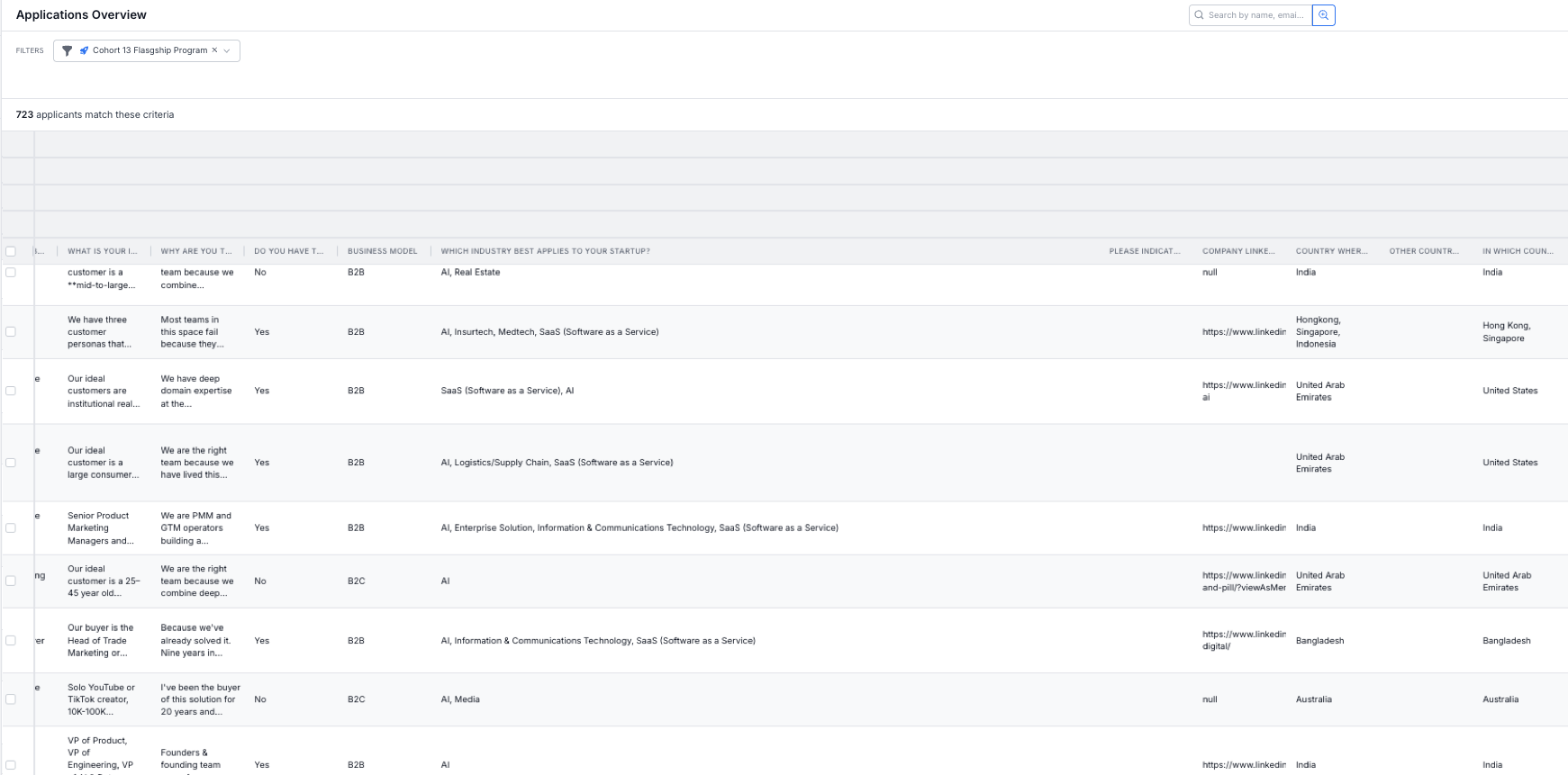
Almost every application we read for C13 mentioned AI.
That sounds like exaggeration but it isn't. When AI shows up in every deck, "we use AI" stops being information. It becomes the same as "we have a website." It tells us nothing about whether the company is differentiated, defensible, or fundable.
Some of this "trend" gave us flashbacks to the web 3 / blockchain / crypto timeline. Or the time when every second company applying was fintech. Or even the time where suddenly every startup was working on greentech / sustainability. The point is, every wave of applications we receive, there is a wave of trends that we can see. This time, we thought we would share our thoughts around AI in startups during the screening phase of our process. Because while this may be another "trend", there's no doubt that AI as a tool and the speed of which the technology is changing made selection this cycle harder than usual. And the work of separating real AI advantage from AI as a marketing layer takes more reading, more questions, and more arguments inside the room.
So when everyone is claiming to be an AI company, what do you actually end up screening for?
(Side note: we wrote about the broader selection process here. This is the part specific to AI.)
Is the AI the product, or is the AI a wrapper?
A meaningful share of the AI applications we saw were built on top of commodity infrastructure that a small, capable team could replicate inside a couple of months, or in some cases, even weeks. That is not a criticism of the founders. It is a statement about where the commodity line sits in 2026. If the moat is the model, the moat is rented. If the moat is proprietary data, a workflow nobody else can replicate, or an integration the customer cannot easily switch out of, the conversation is very different.
Does the valuation reflect AI traction, or AI hype?
Valuation outpacing traction was one of the most common reasons we said no to founders in C13. AI accelerated this problem. Founders heard that AI companies were raising at higher multiples and priced their seed rounds accordingly. The math does not work for a seed fund our size to enter at a valuation that assumes traction the company has not yet hit. And simply put, the AI hype doesn't change that calculation for us.
AI in the pitch deck vs AI in the operations
By the time C13 founders sat in front of us for interviews, the question we kept coming back to was simpler than any of the AI-moat frameworks you read in VC discourse. Can you describe, operationally, where AI is doing work inside your business?
A lot of founders could not.
One B2B founder pitched "vertical AI agents." Pressed in an interview, the founder admitted that 60% of the value the platform delivered was actually their team doing the work manually. An ESG-reporting startup described itself as "LLM-powered" but was, on examination, a digital version of twelve years of consulting they had already been selling. One repeat applicant copy-pasted ChatGPT answers directly into the application form without editing them, which we caught at the phone screen. Let's be really clear. We don't expect founders to handwrite everything and not use the amazing AI tools that are available to them. We do however expect that some strategic thought has gone into the actual use of the tool to enable and accelerate the work.
And this matters more this cycle than in any previous one. Because if we are to play to our strengths, investing in emerging markets, and having seen close to a decade of "startup trends", our selection ultimately comes down to two things:
business fundamentals always matter, and
to lean into exactly what makes this region so unique - with so many opportunities, amidst so challenging to operate within.
Real businesses, real industries, AI as the accelerator
The applications we're most enthusiastic about are actually not AI-native startups in the "Silicon Valley" sense. They are real businesses solving real problems in more traditional industries. Logistics in Indonesia. Healthcare in Bangladesh. Trade finance in Pakistan. Agri in the Philippines. Sectors where things have been done a particular way for decades.
In sectors like those, AI is not the product. AI is the accelerator. The tool is powerful enough now that every operating business should be using it somehow. So the interesting question for us was not whether a founder claimed AI on their deck. It was whether they could point at the specific workflow inside their business where AI is doing actual work. Document parsing. Underwriting decisions. Inventory forecasting. Quality control on a line. Specific, concrete, explainable.
One founder described their AI agents in concrete detail: which agent handles which workflow, what output it produces, where the human still sits in the loop. Another founder, in a completely different sector, articulated the same kind of operational specificity about a marketplace optimisation use case.
And this is where the defensibility question lives. If what you're building is essentially an AI layer without a real business underneath it, a competitor with deeper operational knowledge of your sector can use AI in their own workflow to build something similar faster than you can. They'll ship quicker. They'll take share before you can defend. You need something real underneath the AI. The moat is not the AI. The moat is the business it accelerates.
The founders who could describe their operational AI use had usually built something real. The founders who couldn't had usually put AI in the deck because it sounded good, not because it was doing any work in their business.
None of this is a takedown of AI companies.
We backed AI companies in C13. We back AI companies in most cohorts. What changed this cycle is the sheer volume of AI-adjacent applications, which forced us to be sharper about what AI advantage actually looks like at the seed stage, in emerging markets and what AI alone does not buy.
What we are doing about the bigger picture
The pattern across our application pool raised a question that selection alone cannot answer. What is actually happening with AI adoption across APAC startups, not just the ones applying to us?
We are supporting a new research project into how startups are actually using AI. What tools they pay for, what is working, what is not, and what they have not figured out yet.
If you're running a startup in APAC, the survey takes three minutes. Everyone who completes it gets early access to the full report. Your data goes into the dataset, which means the picture is shaped by your reality, not somebody else's projection.
Take the survey: https://tally.so/r/b58pP1
The report drops in June. We will share it with our LPs, with our portfolio, and with everyone who participated.
Fund 2 is in final close.
Start with the fund deck. Choose your path at acceleratingasia.com/investors and we'll send access.
Ask a question first. Email team@acceleratingasia.com and we'll get back to you.
Ready to invest? Book a call here with a partner.
- Craig & Amra General Partners | Accelerating Asia Ventures
See the portfolio. Check out acceleratingasia.com/portfolio. Filter by country, sector, or fundraising status. Request an introduction directly to any CEO.
For investors and partners. Choose your path at acceleratingasia.com/investors. Whether you're looking to co-invest in individual startups or invest in the fund, the next step is there.
* Carta Q4 2025 VC Fund Performance. US benchmarks used as Asian fund comparables remain limited.
About Accelerating Asia Ventures
Accelerating Asia Ventures is an independent accelerator and venture capital fund investing in early-stage startups across Southeast and South Asia. Founded by operators, the organisation is committed to supporting founders with capital, credibility, and a long-term community.
For interviews, data requests, or portfolio introductions, contact: team@acceleratingasia.com
