
Inside the Selection: How We Chose Cohort 13 From 724 Applications
By Amra Naidoo & Craig Bristol Dixon, General Partners, Accelerating Asia Ventures

By the time we signed off on the Cohort 13 list, we had said no to over 700 startups.
That is the work this piece is about. Not the names that will be public after we announce Cohort 13. The 700+ conversations we had to close in the other direction, and the rigour required to make them well, is the actual product an investor chooses when they decide to invest in our Fund. But, equally as important is also why every cohort we receive and welcome repeat applications. The art and importance of each 'no' is just as important as each 'yes'.
We want to take you inside it.
The work that starts before the application even closes
Of the 700+ applications we read this cycle, roughly 70% were referred in. By existing Limited Partners (LPs AKA investors in our Funds). By other VCs. By alumni founders. By ecosystem partners we have built trust with over eight years and 13 cohorts. The funnel we work from is not a cold inbound pool. It is a curated pipeline pre-qualified by the network we have built.
That changes the shape of selection. We are not screening for whether the applicant is serious. We are screening between serious applicants for the ones we will back with our capital, our team, our 100 days, and our reputation on.
Each application was read end-to-end. Most reached at least two reviewers. The ones that survived the first cull went into structured scoring, multiple rounds, and in some cases days of argument before we landed on the selection we agreed on.
This is the work. Multiply it across 13 cohorts and you have the discipline we are asking investors in our Funds to back.
What we back
Two things, consistently across 13 cohorts.
Operator-founders. We back people who have built things before, whether companies, products, or teams, and who are now building in a market they understand operationally. Not theoretical founders. Not people who have spotted a trend. Operators who have lived inside the problem and are now solving it as a business.
Regional specificity. We do not invest in "Southeast Asia" or "South Asia" as a generic thesis. We invest in specific country-and-sector intersections where the market is structurally underserved. Indonesia logistics. Bangladesh agritech and healthtech. Singapore mobility infrastructure. Philippine small-business credit. These are not fashionable categories. They are categories where a first institutional cheque from us, paired with operator support, produces outsized outcomes.
When we get this combination right, the math just lands.
And the model has one structural advantage that compounds quietly: our accelerator buys an additional 1% equity in each company at no extra cash cost, via the program fee. Compounded across a hundred companies, that 1% materially lifts MOIC for our LPs versus a generalist seed fund backing the same picks. This is what existing LPs are really buying when they come into an AAV fund.
What we are filtering for
Eight years in, our filter is consistent across cohorts. We are looking for a specific kind of founder, building in a specific kind of market, at a specific kind of stage.
Operator-history
We back founders who have built something before. This doesn't mean they've built a startup before. It could be anything. A company, a product, a team inside someone else's company. We are not the right fund for first-time-anything founders chasing a trend. But we are the right fund for operators who have lived inside the problem they are now solving. These are people who have a so-called "secret"… they know something that others don't. Something very specific about the problem they are trying to solve.
The clearest version of this in our portfolio is a founder who ran the Indonesia operations for a foreign logistics platform, watched it refuse to localise, quit, and started her own localised version. She knew the market operationally before she ever pitched us. Today she runs one of our top performing portfolio companies. That archetype, the operator who has already seen the problem from inside the building, repeats across the portfolio.
Tenacity and the ability to pivot
The most successful founders we have backed share a pattern. They are super hustlers. They don't complain about doing the work that needs to be done. Every time there is friction, their reaction is "ok, let's figure it out." They don't get depressed about challenges (ok, maybe they do a little bit - everyone does at some point). But they move on quickly and solve the problem.
This sounds kind of soft and probably generic. Trust us, it is not. It is the single highest-signal predictor we have for how a founder will navigate their coming years, because the first idea is almost never the final one. The founders who survive are the founders who pivot without breaking. The earliest signs of this surface during the selection process itself. How quickly do founders respond to queries? If they have technical issues during our interview call is the locus of control internal or external? And what do they do about it? Or how do they respond to questions they don't know the answers to? Do they deflect, do they blame their team, do they make something up? All of these end up being signals that we pay close attention to.
Regional specificity
We generally invest in country-and-sector intersections, not in regions. Indonesia logistics. Bangladesh agritech. Singapore mobility infrastructure. Philippine small-business credit. The same founder profile in the wrong country-and-sector combination is not a fit, because in APAC the rules of distribution, regulation, talent supply, and customer behaviour change at every border. A founder who has built distribution in Indonesia does not automatically have distribution in the Philippines. The intersection of country and sector is where operator-history compounds. It is also where our LP and mentor network goes deepest, which means it is where we can do the most to help a portfolio company through its next twelve months. We will say no when the match is not there, even when the founder is strong on every other axis.
Integrity under pressure
We look for founders who will do the right thing for their investors as well as their own ambitions. That is harder to test in an application form than the others, because every founder writes the application that makes them look credible. Integrity surfaces in the gap between what a founder says when nothing is at stake and what they do when something is.
Selection week is partly designed to surface this. The same question gets asked in multiple ways, by multiple people across the week, and inconsistencies surface. Reactions to friction tell us how a founder will behave when the friction is bigger and we are not in the room. The 100 days of the program stress-test it further. The LP relationship runs on this. We are stewarding LP capital across a long fund life, and a founder who cuts corners early creates risk the fund has to carry for the rest of that timeline.
Put these four things together and you have what we are filtering 700+ startups out to find. Even when a founder clears all four, the deal itself still has to be cleared, and that is where most of the arguments inside the room actually happen. But selection itself is not the end of the filter. Being chosen for the program is not the same as receiving investment from the fund. Every fund deployment has conditions precedent. KYC, references, deeper diligence on revenue claims, integrity checks that run past what the program itself can surface. Diligence is often the hardest part about making such early stage investments in emerging markets. We're definitely not saying we have this nailed. Anything can happen when investing in such early startups and working over such a long time horizon (a Fund life is 10 years). But there's nothing like literally sitting next to a founder and working with them on a problem, or having a meal or late night drink, that really brings out a person's true personality. A material issue at any of those gates stops the fund from deploying, even after a founder has been accelerated. The work of selection ends when conditions precedent are met and the wire goes out, not when the cohort list is announced. That gate is part of what LPs are paying us to operate.
Five days. Hundreds of meetings.
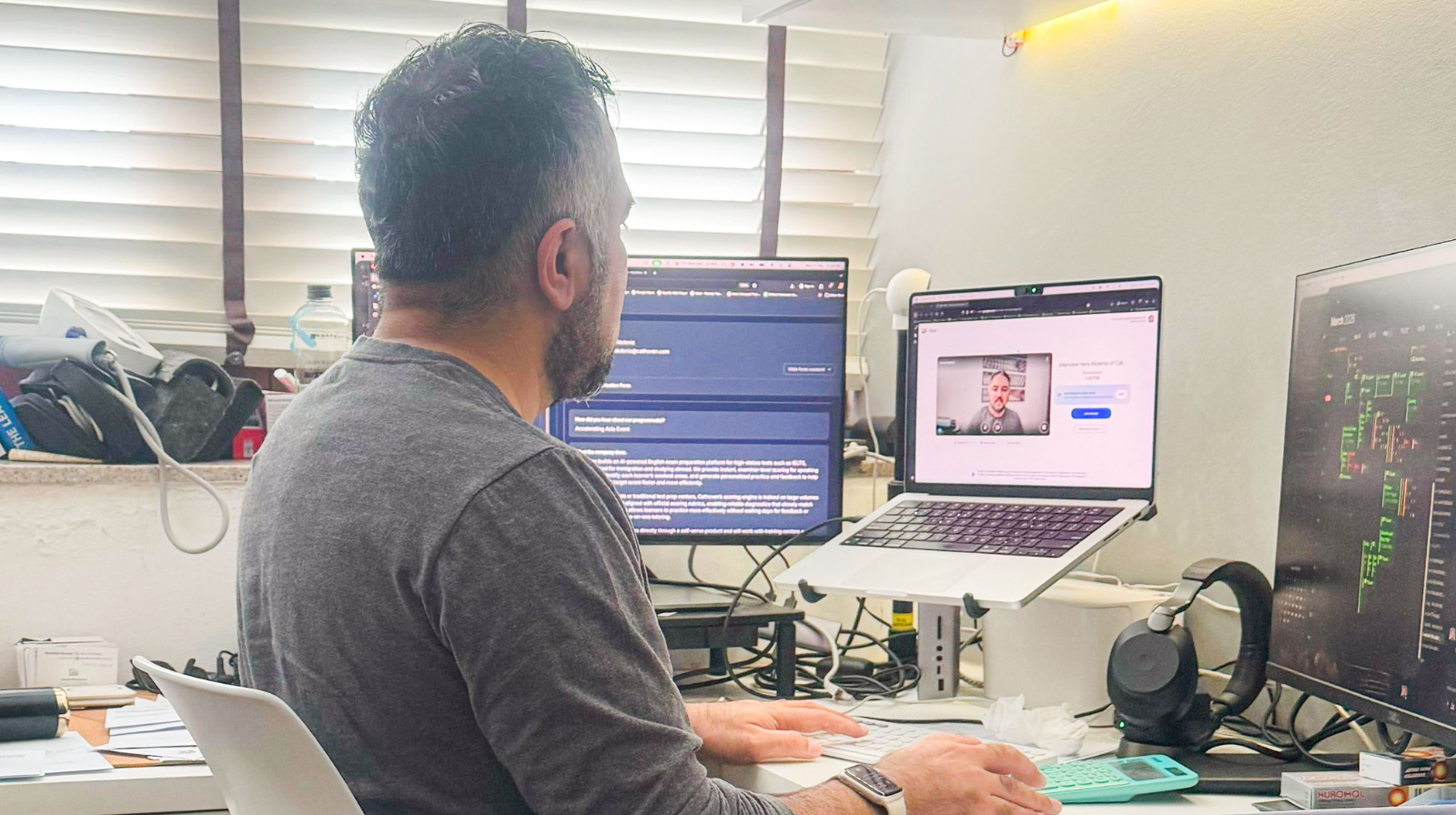
The 700+ applications get narrowed by structured scoring to a top 30-50 or so.
Our scoring is deliberately blunt. Zero is no. Two is yes. One is maybe. We tried more gradation in earlier cohorts and couldn't get consistency across reviewers, because one person's three-out-of-five was another person's four-out-of-five and the rubric stopped telling us anything useful. Collapsing the scale forced the conversation back into the room, which is where it belongs.
After the scoring pass, the surviving applications go into a 10-minute phone screen. Ten minutes seems extremely short, but over the years we've realised this is exactly the perfect amount of time - just enough to confirm stats and check whether the numbers in the application reconcile with what the founder says out loud. From there, founders move into interviews with our team. Each interview is a different vantage point on the same company.
We deliberately ask the same questions in multiple ways across these rounds. Inconsistencies surface. So do the founders who make you feel good in the room without anything underneath the feeling. Several founders we eventually said no to in C13 felt right on a first call and stopped feeling right when the same question came back from a different angle on a later one. That is the point of running the process across multiple people and multiple sittings. It is also why selection week itself exists. Even with the team interviews, no founder gets to a yes on the strength of two or three conversations with our team alone.
The startups who survive that first scoring pass are invited to selection week. Selection week is when the network shows up. We bring in our LPs, our mentors, our co-investing VCs, our ecosystem partners, our domain experts. Each of the 50 startups gets between eight and ten meetings during the week, with different people, from different vantage points. That is between 400 and 500 meetings, every cycle, on the founders we are seriously considering.
Why?
Signal.
When you're working with startups who are relatively so early on in their journey, there's honestly not much to diligence. Looking at bank statements won't tell you much. Any contracts are usually at an early stage. The tech stack could probably be improved. And that's the whole point of the accelerator. But when you are managing investor money, you want to make sure that you're not just doing the proverbial "finger in the air" kind of selection.
So the point is to stress test the founders, the product, the tech, the financials, the pitch and more in a compressed timeframe. So any issues that may have come up in the first month of the program, actually come up in the first 10 minutes of a chat with the right person we've matched the startup with OR in multiple conversations across the week where a founder could possibly be inconsistent with their answers. Selection week surfaces all of this and more.
A startup we score a one after the application can become a clean two after the right operator has spent forty minutes with them and reported back. The same founder can become a zero in the same forty minutes. We use what comes out of those meetings to rescore and to curate the final list.
This is also the part of the process existing LPs get the most out of personally. The structural advantage of being inside selection week is that you meet 50 of the strongest startups in the region in five days, with the AAV team coordinating the diligence and synthesising the signal. Several of our LPs use the week as their own deal flow (and we expect them to). It is part of the relationship.
Where conviction gets forged: the arguments
Every 'yes' in Cohort 13 survived an argument. The arguments are seeded by what came out of selection week and run through the whole team. Here is what some of those arguments looked like for this cohort:
"Boring but fundable"
One of our top picks in almost every cohort is some kind of B2B SaaS with profitable revenue, blue-chip clients, predictable growth, and almost no narrative arc. One of us will always look at this and think, "I am not excited about this but I can see it's going to work." And at the same time, someone else will think, "that is exactly the founder we should be backing." That tension, between the company that excites you and the company that returns your fund, lives inside every selection cycle. In VC the typical startup that grabs all the headlines and media is usually some kind of 'sexy' tech or story. But oftentimes the ones that are just simply really good businesses are a better bet. Balancing investing in moonshot ideas, sexy tech and inspiring founder arcs, versus investing in "just another" b2b SaaS or logistics in X country is a continuous conversation. We back both and we argue about every single one of them.
Founder strong, tech commodity
Every cohort produces at least one application where the founders are really strong but the tech is replicable. The clearest case this cohort came from an AI infrastructure startup. The founders had built before, raised credibly from named angels, recruited a real team. The product however, was something a competent two or three-person team could rebuild in four to eight weeks using off-the-shelf tools. Two well-capitalised competitors were already in the space, one with roughly seventy times their capital and a major cloud partnership. We argued about the founder versus the tech for a significant amount of time. One reviewer scored a zero on the core product. Another scored a two on the team. We eventually said no. The founders were capable. The competitive landscape and the commodification of the underlying tech were not survivable from where we were sitting.
The most common no: valuation out of line with traction
The single most common reason we said no this cycle is the one we have given in every cycle. A founder applies with some traction. Real customers, some revenue. Basically, the start of a promising story. But the valuation they have set assumes the story is already proven. We had a version of this conversation with multiple founders this recruitment cycle. The math does not work for a seed fund our size to enter at a valuation that assumes traction the company has not yet hit. The discipline runs in two directions. It protects our fund economics. It also protects the founder from having to perform up to a valuation the early-stage business cannot yet support. We have watched founders in previous cohorts run into stalled or hard-down rounds because the early valuation was set too high. When we hear ourselves giving the same valuation advice to multiple founders in a single cycle, that is selection working as designed.
A founder we'd back, but the business isn't VC-shaped
A founder applied with real revenue, blue-chip industrial customers, deep technical credibility, and a meaningful product in a category with regulatory tailwinds. Two of our reviewers wrote that this could be an "incredibly profitable private business." That distinction, between a great business and a great venture-shape business, ended the argument. The company could scale. The economics could not scale at the velocity a VC fund needs. We said no, and we pointed the founder toward strategic investors, grants, and a private growth path. Every cohort has at least one of these. Saying no to a founder we like, because the company is the wrong shape for our capital, is one of the harder disciplines the fund operates. It is also what stops us deploying into businesses that are good but would never return the fund.
Founder strong, deal structure wrong
An application produced strong positive signals from mentors and from us. The founders were credible, the market was timely, the underlying technology had a real use case. The block was structural. The technology sat inside a joint venture with a partner who held 50% and the IP. The applying entity had use rights but not ownership. For institutional capital to deploy, the holding company needs to own the technology and the upside outright. The founders had built the company around that arrangement and were not looking to restructure for institutional capital. We respected the call and said no. Pre-screening for deal structure at this stage of the process is one of the parts of selection that quietly protects our LPs from a long diligence process that would never close.
Way too many things going on
A pattern repeated across several founders we considered most seriously this cohort: multiple product workflows in flight, multiple geographies, multiple inbound customer categories. The underlying capability was real every time. The founders were talented every time. The argument in the room was the same in each case. Can this founder narrow to the one workflow, the one market, the one customer profile that creates a repeatable distribution loop, or is the diversification load-bearing for them? When we landed on the second answer, we said no. We have watched founders in previous cohorts who tried to span too much before product-market-fit stall. We have learned, painfully, that focus is a stage-specific discipline. Saying no for lack of focus is also sometimes the first time anyone has told a founder that directly.
The "I would fight for this" tier
On the final weekend, we each wrote down independently the companies we would personally fight for. Most of the list overlapped. Those that didn't are the ones that bring up more fiery conversations.
Ultimately as GPs, we have final say, and we have veto over each other. The pattern that has held across 13 cohorts is this: if one of us is a hard no, the other almost never pushes it, because the downside of accepting the wrong founder is too high. If one of us is a hard yes, the other works to understand what is holding them back, and we reconcile in the room. Both perspectives stay in play. Selection ends when the conversation settles, not when a score averages out.
This is what an LP is buying into when they come into AAV. Not the rubric. The argument. Every yes that joins the portfolio survived someone in the room actively trying to talk us out of it.
Selection is not a single event
If you visit our application page last week, the form was still live (it's down now while we prepare to launch Cohort 14 applications). That is not a mistake. Even after we close the official application window, we are still reviewing.
We re-open conversations with startups we previously said no to, because a question that surfaced inside selection week sometimes reframes one of those earlier rejections. We look at the shortlisted companies as a batch, not as a list of individual decisions, because a cohort has a shape and we need to see what is missing in it as well as what is in it. We talk to our LPs about specific companies, because some of them are operators in adjacent sectors and the best diligence we have on the unknowns sits inside our LP base. We talk to mentors about specific industries, and the moats they describe sometimes look very different from the ones the founder is claiming.
Every one of those conversations can shift a decision that previously looked settled. That is part of why the yes-list lands where it lands. It is not the output of an averaged score. It is the output of weeks of overlapping conversations, many of which happen after the formal scoring window has closed.
Structural discipline against our own blind spots
The process is not perfect. The volume of applications, the number of reviewers, the operational pressure of selection week, all create opportunities for a strong founder to fall into a momentum gap between stages. We know it happens.
What we have built is a structural catch. Before any rejection email leaves AAV, every application that scored at the borderline gets a final review by one of us personally. That review is the mechanism that gives another opportunity to pull startups out of the rejection pile and into an interview. The catch is not luck. It is a built process that runs on every cycle, designed for exactly this kind of miss.
The same discipline applies to reviewer bias. The structural answer to a reviewer's pattern-bias is not to remove the bias. It is to make sure no single reviewer is the only person looking at any one application.
Why we go through all of this
Less than 1% of C13 applications made it through. 100 companies in the portfolio across two funds, every one of them through some version of this same filter. The math that closes the gap between a fund deck and a return is sitting inside this filter, not inside the deck.
The clearest version of this we have ever heard came from one of our existing LPs. Asked why he invests in AAV, his answer was three words.
Transparency. Integrity. Diversification.
That is what the work above produces.
One note for founders
If you applied to Cohort 13 and did not get through, the work described above is the rigour we put your application through. Cohort 14 opens shortly and is Fund 2's last cohort. The question we ask of every repeat applicant is the one we always ask: what changed? If something material has changed since your last application, this is the cohort to come back with.
If you want to see what comes out the other end of this filter, the active portfolio is at acceleratingasia.com/portfolio.
Fund 2 is in final close.
Start with the fund deck. Choose your path at acceleratingasia.com/investors and we'll send access.
Ask a question first. Email team@acceleratingasia.com and we'll get back to you.
Ready to invest? Book a call here with a partner.
- Craig & Amra General Partners | Accelerating Asia Ventures
See the portfolio. Check out acceleratingasia.com/portfolio. Filter by country, sector, or fundraising status. Request an introduction directly to any CEO.
For investors and partners. Choose your path at acceleratingasia.com/investors. Whether you're looking to co-invest in individual startups or invest in the fund, the next step is there.
* Carta Q4 2025 VC Fund Performance. US benchmarks used as Asian fund comparables remain limited.
About Accelerating Asia Ventures
Accelerating Asia Ventures is an independent accelerator and venture capital fund investing in early-stage startups across Southeast and South Asia. Founded by operators, the organisation is committed to supporting founders with capital, credibility, and a long-term community.
For interviews, data requests, or portfolio introductions, contact: team@acceleratingasia.com
