
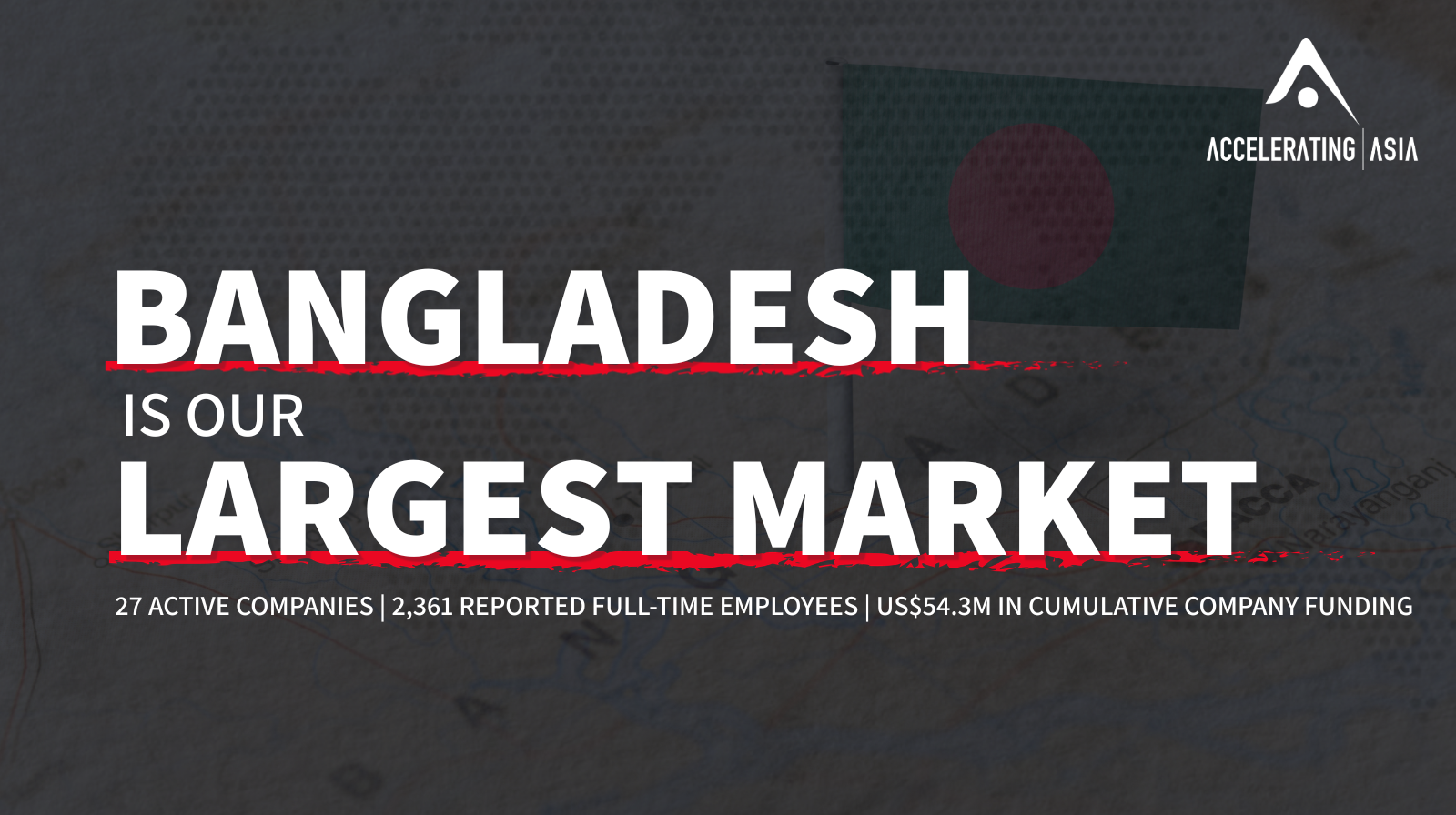
Let's address the elephant in the room. Bangladesh is the largest market in the Accelerating Asia portfolio. Fund 2 has invested US$1.8 million across 18 companies there, and across Funds 1 and 2, 27 of our active portfolio companies operate in the country.
That is a meaningful country concentration. For anybody assessing Fund 2, it isn't a side story or a footnote. Investors should absolutely ask us why, how deliberate the exposure is and what happens if the market becomes more difficult.
This concentration wasn't created by setting a country allocation and filling it. It was built company by company, over eight years. Fund 2 invests more where our sourcing advantage and the evidence from individual companies are strongest. Bangladesh has repeatedly met that test.
The question for an LP isn't whether Bangladesh is difficult. It is whether we have an advantage in finding and assessing companies there, whether those companies are showing evidence of scale, and whether the wider fund is constructed to manage the country risk.
The macro direction is changing
The wider market is beginning to shift too. There are signs that serious capital is moving back into the country.
Net foreign direct investment increased 39.36% in 2025 to US$1.77 billion, after several difficult years. It then rose another 12.78% year on year between April and June 2026. Source: Invest Bangladesh, May and October 2026
Some of the most visible commitments are in port infrastructure. APM Terminals is developing the US$550 million Laldia Container Terminal, described as the largest European foreign direct investment in Bangladesh's history. DP World has signed a 15-year concession to operate and modernise the New Mooring Container Terminal, including an investment commitment exceeding BDT 1,000 crore over its first ten years. Sources: Invest Bangladesh on the Laldia and New Mooring projects
These aren't startup investments and they have no direct relationship to our portfolio. They are relevant as evidence that major international operators are making long-term commitments to Bangladesh's trade and manufacturing infrastructure.
The startup capital market is also being rebuilt
The need is obvious. Global investors supplied approximately 99% of Bangladesh's startup funding in 2025, but the three largest transactions represented approximately 95% of the total and early-stage funding declined. A few large rounds made the headline number look healthier than the funding environment most founders were actually operating in. Source: Startup Bangladesh and LightCastle Partners, 2025 Year in Review
Two new vehicles are trying to change that. In August, Startup Bangladesh began operating the BDT 400 crore Bangladesh Fund of Funds, which will channel public capital through local and international professional fund managers rather than only investing directly into individual companies. Source: Startup Bangladesh
Separately, 39 Bangladeshi commercial banks have backed Bangladesh Startup Investment Company and its US$35 million ONKUR fund. The vehicle is intended to invest from seed through later venture stages and co-invest alongside global managers, with additional working-capital support for portfolio companies. Source: Bangladesh Startup Investment Company
Neither vehicle guarantees good deployment or future returns. What matters is that Bangladesh is beginning to build permanent capital infrastructure around startups, rather than relying only on occasional government programmes or a few large foreign rounds.
There is also a growing connection to the Gulf. Gulf-based investors contributed roughly one-third of the global capital invested in Bangladesh startups in 2025. For some South Asian founders, the Middle East is becoming part of the customer pipeline, fundraising strategy and company structure much earlier than it used to be.
Where complexity creates opportunity
Bangladesh has no shortage of difficult problems. Essential systems across healthcare, agriculture, financial services, commerce and logistics remain fragmented or inefficient. That complexity creates room for locally informed companies to build solutions that customers will pay for.
That doesn't make every problem a venture opportunity, and difficulty alone isn't an investment thesis. We are looking for the smaller group of founders who can turn a structural problem into a paid product, build distribution and create a company capable of scaling beyond its first market.
Eight years of sourcing before the headline changed
Fund 2 isn't entering Bangladesh because these institutions have appeared. We have eight years of sourcing and portfolio history there already.
Bangladesh has been the largest reported operating market in each of our last three application datasets. Across Cohorts 12 to 14, it accounted for 185 of 755 submitted applications. That volume lets us compare companies inside the same market, understand how local business models behave and become more selective about what deserves investment.
The quality of that pipeline is changing too. For Cohort 14, 76.5% of the Bangladesh applicants described themselves as revenue-generating, compared with 55.8% for Cohort 13 and 56.9% for Cohort 12. The data is self-reported and revenue alone doesn't make a company investable, but more founders are reaching us after somebody has already paid for what they are building.
Together, as of July, those active companies reported 2,361 full-time employees and approximately US$54.3 million in cumulative company funding. They operate across healthcare, agriculture, financial services, commerce, education, mobility and enterprise technology.
PulseTech joined Cohort 10 reporting US$2.5 million in annualised revenue. By June 2026, it reported US$150 million in annualised revenue, more than 14,000 pharmacies and profitability. Startup Bangladesh has already sold its PulseTech stake in what both organisations described as a multi-fold return, its first portfolio exit. Accelerating Asia remains invested through Fund 2.
Hishabee (Cohort 7) spent three years building the operating and lending infrastructure required to bring its embedded-finance model to market. We recently invested again, even though our first cheque is normally where we expect to generate our highest return on invested capital. The second investment had to earn its place against the option of backing another new company at the earliest stage.
Markopolo (Cohort 6) started in Dhaka, went through HF0 in Silicon Valley and has raised US$3.5 million, including a US$2 million seed round led by Joa Capital in Saudi Arabia. Its teams now operate across the United States, Saudi Arabia, Bangladesh and India.
These companies show three different paths: scale inside the domestic market, patient infrastructure building around a local problem and using Bangladesh as the starting point for a global business.
The portfolio is also moving into a different stage. Across our 105-company portfolio, several of the more mature companies are under active review for potential strategic acquisitions, secondary sales or liquidity through later-stage financing. Bangladesh-linked holdings on the current exit-watch list include Markopolo and PulseTech.
These are possible pathways, not contracted exits. They do, however, give an LP joining Fund 2 at final close more visibility into potential liquidity than investors had when the fund launched.
The risks haven't disappeared
The latest World Bank Bangladesh Development Update projects economic growth of 3.4% in both FY26 and FY27. Investment has softened, inflation remains high and the non-performing loan ratio reached 33.2% in June 2026. Energy supply, currency exposure, domestic revenue collection and financial-sector weakness all affect the companies we back. Source: World Bank, October 2026
The new capital, infrastructure commitments and startup funding vehicles matter, but they don't cancel these risks. We still underwrite each company on its own evidence and keep the wider fund diversified across 16 markets. Fund 2 isn't dependent on one Bangladesh recovery story, government programme or source of follow-on capital, and we can adjust future deployment as markets and opportunities change.
What an LP can assess now
For a prospective LP, this is no longer an abstract thesis. Our sourcing history, the portfolio's progress and the risks that remain can all be examined now.
An LP joining Fund 2 at final close participates in the existing portfolio, with capital contribution and equalisation handled through the fund mechanics. This isn't a future Bangladesh strategy. The companies and the exposure are already there to assess.
From 24 to 27 November, we will also be in Bangladesh with a small group of investors, meeting portfolio founders, local investors and ecosystem partners. It is an opportunity to test the argument in the market rather than taking it from an article or fund deck.
Fund 2 closes at the end of this year. If you are considering the fund or would like to join us in Bangladesh, visit https://acceleratingasia.com/investors and book a call with Craig or Amra.
See the portfolio. Check out acceleratingasia.com/portfolio. Filter by country, sector, or fundraising status. Request an introduction directly to any CEO.
For investors and partners. Choose your path at acceleratingasia.com/investors. Whether you're looking to co-invest in individual startups or invest in the fund, the next step is there.
* Carta Q4 2025 VC Fund Performance. US benchmarks used as Asian fund comparables remain limited.
About Accelerating Asia Ventures
Accelerating Asia Ventures is an independent accelerator and venture capital fund investing in early-stage startups across Southeast and South Asia. Founded by operators, the organisation is committed to supporting founders with capital, credibility, and a long-term community.
For interviews, data requests, or portfolio introductions, contact: team@acceleratingasia.com
